<?xml version="1.0" encoding="utf-8"?><feed xmlns="http://www.w3.org/2005/Atom" ><generator uri="https://jekyllrb.com/" version="3.10.0">Jekyll</generator><link href="https://liusiyi641.github.io/feed.xml" rel="self" type="application/atom+xml" /><link href="https://liusiyi641.github.io/" rel="alternate" type="text/html" /><updated>2026-11-07T18:31:14+00:00</updated><id>https://liusiyi641.github.io/feed.xml</id><title type="html">Siyi Liu’s Homepage</title><subtitle>Siyi Liu&apos;s academic portfolio - PhD student at University of Pennsylvania</subtitle><author><name>Siyi Liu</name><email>siyiliu@seas.upenn.edu</email></author><entry><title type="html">Misinformation Attack: Can AI Search Survive a Flood of Machine-Generated Misinformation?</title><link href="https://liusiyi641.github.io/posts/2026/06/misinformation-attack/" rel="alternate" type="text/html" title="Misinformation Attack: Can AI Search Survive a Flood of Machine-Generated Misinformation?" /><published>2026-06-08T00:00:00+00:00</published><updated>2026-06-08T00:00:00+00:00</updated><id>https://liusiyi641.github.io/posts/2026/06/misinformation-attack</id><content type="html" xml:base="https://liusiyi641.github.io/posts/2026/06/misinformation-attack/"><![CDATA[<blockquote>
  <p><strong>TL;DR</strong>: Modern AI assistants answer questions by retrieving from the live web (RAG), and they quietly assume the web is <em>trustworthy</em>. <strong>Misinformation Attack</strong> stress-tests that assumption with an ethical, fabricated-entity testbed. After <strong>47 days, 30 synthetic entities, 5 prompts per entity, 5 AI-search systems, and 24,722 scored responses</strong>, the clearest initial result is that <strong>the system and its search backend matter far more than the website</strong>: citation rates ranged from <strong>93.9% for Perplexity to 0% for Claude/Brave</strong>. Just as importantly, retrieval does not imply belief—GPT sometimes found and cited the sites while consistently refusing to treat the entities as independently verified.</p>

  <p><em>This is an ongoing project. The first establishment/visibility study is complete; the misinformation dose-response experiments are the next stage.</em></p>
</blockquote>

<hr />

<h2 id="the-problem-retrieval-is-only-as-trustworthy-as-the-web">The problem: retrieval is only as trustworthy as the web</h2>

<p>Tools like ChatGPT Search, Gemini, Perplexity, and Copilot increasingly answer your questions by <strong>retrieving documents from the open web</strong> and summarizing them. This is powerful — but it rests on one fragile assumption:</p>

<blockquote>
  <p><strong>The retrieved context is trustworthy.</strong></p>
</blockquote>

<p>Generative AI has made it cheap to mass-produce fluent, plausible, false content. So a natural and worrying question follows:</p>

<blockquote>
  <p><strong>What if an adversary floods the web with AI-generated falsehoods about a target — and the AI dutifully repeats them as fact?</strong></p>
</blockquote>

<p>Call this the <strong>misinformation attack</strong>. Unlike a one-off prompt injection, it attacks the <em>information ecosystem</em> that RAG systems depend on. If a handful of fake articles can swing what an AI says about a person, a company, or a product, that’s a real-world safety problem — especially for <strong>ordinary, low-profile people</strong> who have no protective web presence to drown out the noise.</p>

<hr />

<h2 id="three-research-questions">Three research questions</h2>

<p><strong>Misinformation Attack</strong> is organized around three questions, moving from <em>measuring</em> the threat to <em>defending</em> against it:</p>

<ol>
  <li><strong>Vulnerability scaling.</strong> How much does it take? Concretely: <strong>how many fabricated articles must an adversary publish</strong> before a production AI system produces false, untruthful claims about an entity?</li>
  <li><strong>Do existing defenses hold?</strong> Certified and heuristic RAG defenses (RobustRAG, ReliabilityRAG, TrustRAG, AstuteRAG) promise robustness. <strong>Do they actually survive the flood regime</strong> — many coordinated malicious sources rather than a few?</li>
  <li><strong>Can we fix it?</strong> Can we design a defense that combines the <strong>retrieval layer</strong> (what gets trusted) and the <strong>LLM layer</strong> (how conflicting evidence is reasoned about) to bend the curve back?</li>
</ol>

<p>This post focuses on <strong>RQ1</strong> — the measurement that makes everything else quantitative. The first 47-day study establishes the baseline: whether each system can retrieve the synthetic entities and whether it subsequently treats them as real.</p>

<hr />

<h2 id="the-core-idea-attack-fabricated-entities-not-real-people">The core idea: attack <em>fabricated</em> entities, not real people</h2>

<p>The scientifically ideal experiment — pollute the web about a real target and see when the AI breaks — is also clearly unethical. The key design move in Misinformation Attack resolves this tension:</p>

<blockquote>
  <p><strong>Invent entities that don’t exist, give them a believable web presence, confirm that production AI systems treat them as real, and then attack the <em>fabricated</em> entities.</strong></p>
</blockquote>

<p>Because <strong>no real person is ever attacked</strong>, the ethical footprint drops sharply. Scientific validity is preserved by a <strong>proxy-validity argument</strong>: I show the fabricated entities are statistically <em>indistinguishable</em> — in how “known” they are to the AI — from real low-profile entities. If the fake entities look just like comparable real people to the model, then the attack dose measured on the fakes <strong>estimates the dose that would harm comparable real people</strong>.</p>

<p>The domains I work with include tennis players, companies, and institutions: checkable facts, low real-world harm, narratively rich, and free of medical/political sensitivity. Each fabricated entity gets a fixed ground-truth record (nationality/location, ranking, coach, etc.), and “truth” is operationally defined as that originally-seeded record.</p>

<hr />

<!-- ## Two scaling questions, not one

A central contribution is separating two doses that are usually conflated:

- **Establishment dose** — how much content turns a *non-existent* entity into one the AI confidently "knows"? *(non-existent → correctly known)*
- **Attack dose** — given an *established, correctly-known* entity, how much adversarial content flips the AI to a falsehood? *(correctly known → falsely known)*

Measuring both lets me ask the socially important question: **how much does a clean, established footprint actually protect an entity** from being defamed?

--- -->

<!-- ## What I'm building

Take tennis players as an example. To make a fabricated entity look organically real (and therefore indexable and retrievable), each one gets a small, cross-linked ecosystem:

- An official-looking **player site** on its own domain.
<!-- - A **stats/database-style** entry. -->
<ul>
  <li>A few <strong>articles</strong> (match report, profile, opinion) across separate domains.
<!-- - A **self-hosted discussion thread** where three distinct **fan personas** (e.g., a UK skeptic, a China enthusiast, a US stats nerd) talk about the player and link back — the inbound links are what make the cluster indexable. --></li>
</ul>

<p>I deliberately use <strong>venues I control</strong> rather than deceiving users on real platforms, and every fabricated name is <strong>footprint-verified</strong> to collide with no real person before use.</p>

<p>Two claim types let me test whether <em>what</em> you lie about matters:</p>

<ul>
  <li><strong>Neutral-false</strong> — a wrong statistic (e.g., career-high #84 asserted as #12).</li>
  <li><strong>Reputationally-damaging-false</strong> — a fabricated ban or violation, which may trip model safety behavior. <strong>If damaging claims are harder to plant, that’s itself a finding.</strong> –&gt;</li>
</ul>

<hr />

<h2 id="how-the-experiment-runs">How the experiment runs</h2>

<ul>
  <li><strong>Phase 0 — Pilot.</strong> Validate the pipeline on 2–3 entities and measure <strong>indexing latency</strong>, the binding constraint on the whole timeline.</li>
  <li><strong>Phase 1 — Establishment.</strong> Publish establishment content at varying doses; track “knownness” weekly across all target models; run the <strong>proxy-validity</strong> comparison against real low-profile players.</li>
  <li><strong>Phase 2 — Attack.</strong> Inject adversarial content and <strong>sweep the attack dose</strong> (1, 3, 10, 30, … pages), using un-attacked controls to separate real attack effects from natural answer drift.</li>
  <li><strong>Phase 3 — Defense.</strong> Evaluate detection and mitigation methods, then develop stronger defenses against misinformation attacks.</li>
  <li><strong>Phase 4 — Takedown &amp; persistence.</strong> Remove the content and measure the <strong>attack half-life</strong> — how long the AI keeps repeating the falsehood after the source is gone.</li>
</ul>

<p><strong>Models under test:</strong> ChatGPT Search, Gemini (with Search), Perplexity, Claude (web search), Grok, and Bing/Copilot — reported per model.</p>

<hr />
<!--
## What gets measured

The headline quantity is **Dose-to-Flip** `D50(e)` — the smallest adversarial dose at which the model asserts the falsehood at least half the time. Alongside it:

- **Attack Success Rate** `ASR(e, d)` and the full **answer-state migration** from truth → target-falsehood → refusal as dose rises.
- **Entity-relative dose** `d* = D50 / footprint size` — a normalized number comparable *across* entities, and the bridge to the real-world claim.
- **Adversarial-citation share** — linking the behavioral flip back to the retrieval channel.
- **Confidence-when-wrong** — is the model *confidently* wrong as the flood grows?
- **Persistence / half-life** after takedown.

Every curve comes with bootstrap confidence intervals, and dose-to-flip is reported as a **distribution over phrasings**, not a single cherry-picked number. -->

<!-- --- -->

<h2 id="ethics-first">Ethics first</h2>

<p>The entity design is what makes this <em>defensible</em> — but it’s lower-harm, not zero-harm, and I treat ethics as a first-class part of the project:</p>

<ul>
  <li><strong>No real targets.</strong> Real entities are <em>measured</em> for knownness only, never attacked.</li>
  <li><strong>Low-harm domain</strong>, minimal footprint, prompt takedown, and search-engine decache requests.</li>
  <li><strong>Provenance markers</strong> so future crawlers can identify the content as fabricated.</li>
  <li><strong>Dual-use mitigation</strong>: gate the weaponizable operational details, release the <strong>evaluation harness</strong> (not the recipe), and pair the attack with the RQ3 defense.</li>
  <li><strong>Responsible disclosure</strong> to providers before publication, and <strong>early IRB</strong> consultation.</li>
</ul>

<hr />

<h2 id="why-this-matters">Why this matters</h2>

<p>If a small number of coordinated fake sources can reliably flip what production AI says about an entity, then “the model cites its sources” is a false comfort — and the people most exposed are exactly those without a strong web presence to defend them. Misinformation Attack aims to turn that worry into a <strong>measured scaling law</strong>: a number for how fragile RAG is, evidence on whether today’s defenses can bend it, and a path toward a defense that can.</p>

<blockquote>
  <p><strong>From “we measured a number” to “we measured a scaling law that current defenses can’t bend — and built one that can.”</strong></p>
</blockquote>

<hr />

<h2 id="progress-log">Progress log</h2>

<p><strong>Sep 10, 2026 — Initial visibility study completed.</strong> From July 25 through September 10, I probed 30 synthetic entities using five prompts across five AI-search systems. The resulting dataset contains <strong>24,722 scored responses</strong>.</p>

<h3 id="initial-results-the-search-system-dominates">Initial results: the search system dominates</h3>

<p>The same entities, sites, and prompts produced radically different outcomes:</p>

<table>
  <thead>
    <tr>
      <th>System</th>
      <th>Search backend</th>
      <th style="text-align: right">Responses</th>
      <th style="text-align: right">Responses citing a test site</th>
      <th style="text-align: right">Entities ever cited</th>
    </tr>
  </thead>
  <tbody>
    <tr>
      <td>Perplexity (Sonar)</td>
      <td>Perplexity index</td>
      <td style="text-align: right">4,201</td>
      <td style="text-align: right"><strong>93.9%</strong></td>
      <td style="text-align: right">30/30</td>
    </tr>
    <tr>
      <td>Gemini (3.5 Flash)</td>
      <td>Google</td>
      <td style="text-align: right">4,972</td>
      <td style="text-align: right"><strong>83.8%</strong></td>
      <td style="text-align: right">30/30</td>
    </tr>
    <tr>
      <td>Grok (4.3)</td>
      <td>Live crawl</td>
      <td style="text-align: right">4,292</td>
      <td style="text-align: right"><strong>66.7%</strong></td>
      <td style="text-align: right">30/30</td>
    </tr>
    <tr>
      <td>GPT (5.4 mini)</td>
      <td>Bing</td>
      <td style="text-align: right">5,101</td>
      <td style="text-align: right"><strong>11.4%</strong></td>
      <td style="text-align: right">15/30</td>
    </tr>
    <tr>
      <td>Claude (Haiku 4.5)</td>
      <td>Brave</td>
      <td style="text-align: right">5,103</td>
      <td style="text-align: right"><strong>0.0%</strong></td>
      <td style="text-align: right">0/30</td>
    </tr>
  </tbody>
</table>

<p>Claude searched normally and returned result URLs, but none of the test domains appeared in 5,103 responses. Because the API exposes its raw search results, this is a measured absence from the Brave-backed retrieval results rather than an inference from the model’s silence.</p>

<h3 id="retrieval-and-belief-are-separate-failure-points">Retrieval and belief are separate failure points</h3>

<p>The most important conceptual result is that <strong>finding a source is not the same as believing it</strong>. GPT cited the test sites in <strong>581 responses across 15 entities</strong>, yet on all 34 judged run-days it never classified an entity as real. It usually described what the site claimed while noting the lack of independent corroboration, often using the sites’ own research disclaimers as evidence.</p>

<p>Gemini behaved very differently on the same pages, regularly treating 25–30 entities per run as real. A citation-only evaluation would make GPT and Gemini look different merely in degree; in practice, they differ in kind. This means the larger attack study must measure at least two axes:</p>

<ol>
  <li><strong>Retrieval penetration:</strong> did the system find and cite the planted source?</li>
  <li><strong>Belief penetration:</strong> did the answer adopt the source’s claims as factual?</li>
</ol>

<h3 id="indexing-changed-over-time">Indexing changed over time</h3>

<ul>
  <li><strong>Google indexed fastest:</strong> Gemini went from 0 to 26 covered entities within three days, before any manual submission.</li>
  <li><strong>Bing indexed slowest but continued climbing:</strong> GPT first cited a test site eight days after submission through Bing Webmaster Tools and IndexNow, then grew from 2 to 15 covered entities.</li>
  <li><strong>Gemini’s coverage later declined:</strong> it cited a mean of 29.9 entities per run from August 3–15, versus 24.3 from August 17 onward.</li>
  <li><strong>Grok’s apparent collapse is confounded:</strong> citations fell from 145/150 responses on August 19 to 0/150 from August 27 onward, but the break coincided with an OpenRouter key replacement. The model and prompts were unchanged and search continued, so this looks like a real retrieval change, but it cannot be cleanly attributed to xAI.</li>
</ul>

<h3 id="what-didand-did-notaffect-visibility">What did—and did not—affect visibility</h3>

<p>Only GPT/Bing retained enough site-level variation for a useful comparison; Perplexity, Gemini, and Grok each eventually cited all 30 entities.</p>

<ul>
  <li><strong>Single-page sites were more discoverable by GPT/Bing:</strong> 14/18 were ever cited, compared with 1/12 multi-page sites (Fisher’s exact test, <code class="language-plaintext highlighter-rouge">p = 0.00048</code>). This is not clean evidence that fewer pages are inherently better: page count was entangled with builder choice, JSON-LD, and—in ten sites—an initially broken canonical domain. A plausible explanation is that low-authority sites had only their homepages crawled.</li>
  <li><strong>Link structure had no detectable effect:</strong> even both tennis sites with neither inbound nor outbound links were discovered. The groups contain only 2–3 sites each, so this rules out only very large effects.</li>
  <li><strong>Prompt phrasing did not materially change retrieval:</strong> citation rates remained nearly flat across the five prompts. The unique entity name appeared sufficient to drive retrieval, although phrasing did affect whether answers hedged.</li>
</ul>

<h3 id="current-interpretation-and-limitations">Current interpretation and limitations</h3>

<p>These are <strong>visibility and establishment results, not yet misinformation-attack success rates</strong>. Citation counts are derived directly from URLs and are the most reliable measurements. Belief labels come from a text classifier that over-counted belief for some providers—especially Grok—so the strongest belief claims above use hand-audited results.</p>

<p>Other caveats include unequal numbers of run-days across providers, configuration changes during the study, small entity subgroups, and contamination after the public project writeup began appearing in GPT’s search results. The next stage will use this baseline to select established entities and measure the adversarial dose required to move answers from truthful or uncertain to confidently false.</p>

<p><strong>Aug 2026 — Entity ecosystems built and deployed.</strong> I’ve stood up and deployed the first batch of websites. These are now live and entering the indexing/knownness-measurement phase (Phase 1). The deployed research sites are listed below.</p>

<h3 id="deployed-research-sites-in-use">Deployed research sites (in use)</h3>

<p><strong>sites &amp; databases</strong></p>

<ul>
  <li><a href="https://aldenbrook.netlify.app">https://aldenbrook.netlify.app</a></li>
  <li><a href="https://bramlee.netlify.app/">https://bramlee.netlify.app/</a></li>
  <li><a href="https://brindlemark.netlify.app">https://brindlemark.netlify.app</a></li>
  <li><a href="https://caelthorn.netlify.app">https://caelthorn.netlify.app</a></li>
  <li><a href="https://calverne.netlify.app">https://calverne.netlify.app</a></li>
  <li><a href="https://cindergrid.netlify.app">https://cindergrid.netlify.app</a></li>
  <li><a href="https://corolane.netlify.app/">https://corolane.netlify.app/</a></li>
  <li><a href="https://corvath.netlify.app/">https://corvath.netlify.app/</a></li>
  <li><a href="https://ellwickacademy.netlify.app">https://ellwickacademy.netlify.app</a></li>
  <li><a href="https://kairvane.netlify.app">https://kairvane.netlify.app</a></li>
  <li><a href="https://kesterline.netlify.app">https://kesterline.netlify.app</a></li>
  <li><a href="https://marnley.netlify.app">https://marnley.netlify.app</a></li>
  <li><a href="https://merasyl.netlify.app">https://merasyl.netlify.app</a></li>
  <li><a href="https://orisetteacademy.netlify.app">https://orisetteacademy.netlify.app</a></li>
  <li><a href="https://orlein.netlify.app">https://orlein.netlify.app</a></li>
  <li><a href="https://orrivex.netlify.app">https://orrivex.netlify.app</a></li>
  <li><a href="https://quorivane.netlify.app">https://quorivane.netlify.app</a></li>
  <li><a href="https://sennvue.netlify.app">https://sennvue.netlify.app</a></li>
  <li><a href="https://valescend.netlify.app/">https://valescend.netlify.app/</a></li>
  <li><a href="https://vantrelle.netlify.app">https://vantrelle.netlify.app</a></li>
</ul>

<p><strong>Tennis players</strong></p>

<ul>
  <li><a href="https://alina-morren.netlify.app/">https://alina-morren.netlify.app/</a></li>
  <li><a href="https://davrik-tolsenne.netlify.app/">https://davrik-tolsenne.netlify.app/</a></li>
  <li><a href="https://emil-kevir.netlify.app/">https://emil-kevir.netlify.app/</a></li>
  <li><a href="https://kira-orsenn.netlify.app/">https://kira-orsenn.netlify.app/</a></li>
  <li><a href="https://luca-pellis.netlify.app">https://luca-pellis.netlify.app</a></li>
  <li><a href="https://mireya-voss.netlify.app">https://mireya-voss.netlify.app</a></li>
  <li><a href="https://noemi-calvett.netlify.app">https://noemi-calvett.netlify.app</a></li>
  <li><a href="https://rafael-delvar.netlify.app">https://rafael-delvar.netlify.app</a></li>
  <li><a href="https://sylvra-quenmark.netlify.app">https://sylvra-quenmark.netlify.app</a></li>
  <li><a href="https://tomas-sarnell.netlify.app">https://tomas-sarnell.netlify.app</a></li>
</ul>

<h3 id="phase-2-attack-articles-substack">Phase 2 attack articles (Substack)</h3>

<p><strong>Nov 2026 — Revised attack corpus deployed.</strong> The second phase now uses 30 controlled Substack articles: 15 factual/control articles in <em>Baseline Ledger</em> and 15 fabricated defamation/attack articles in <em>Enterprise Risk Digest</em>.</p>

<p><strong>Factual/control articles — Baseline Ledger</strong></p>

<ul>
  <li><a href="https://baselineledger.substack.com/p/alina-morren__a01html">https://baselineledger.substack.com/p/alina-morren__a01html</a></li>
  <li><a href="https://baselineledger.substack.com/p/bramleecom__a01html">https://baselineledger.substack.com/p/bramleecom__a01html</a></li>
  <li><a href="https://baselineledger.substack.com/p/brindlemark-institute__a01html">https://baselineledger.substack.com/p/brindlemark-institute__a01html</a></li>
  <li><a href="https://baselineledger.substack.com/p/caelthorn-climate-institute__a01html">https://baselineledger.substack.com/p/caelthorn-climate-institute__a01html</a></li>
  <li><a href="https://baselineledger.substack.com/p/calverneorg__a01html">https://baselineledger.substack.com/p/calverneorg__a01html</a></li>
  <li><a href="https://baselineledger.substack.com/p/cindergridcom__a01html">https://baselineledger.substack.com/p/cindergridcom__a01html</a></li>
  <li><a href="https://baselineledger.substack.com/p/kairvane-labs__a01html">https://baselineledger.substack.com/p/kairvane-labs__a01html</a></li>
  <li><a href="https://baselineledger.substack.com/p/kira-orsenn__a01html">https://baselineledger.substack.com/p/kira-orsenn__a01html</a></li>
  <li><a href="https://baselineledger.substack.com/p/luca-pellis__a01html">https://baselineledger.substack.com/p/luca-pellis__a01html</a></li>
  <li><a href="https://baselineledger.substack.com/p/marnleyorg__a01html">https://baselineledger.substack.com/p/marnleyorg__a01html</a></li>
  <li><a href="https://baselineledger.substack.com/p/merasyl-networks__a01html">https://baselineledger.substack.com/p/merasyl-networks__a01html</a></li>
  <li><a href="https://baselineledger.substack.com/p/noemi-calvett__a01html">https://baselineledger.substack.com/p/noemi-calvett__a01html</a></li>
  <li><a href="https://baselineledger.substack.com/p/orisette-academy__a01html">https://baselineledger.substack.com/p/orisette-academy__a01html</a></li>
  <li><a href="https://baselineledger.substack.com/p/orrivex-systems__a01html">https://baselineledger.substack.com/p/orrivex-systems__a01html</a></li>
  <li><a href="https://baselineledger.substack.com/p/rafael-delvar__a01html">https://baselineledger.substack.com/p/rafael-delvar__a01html</a></li>
</ul>

<p><strong>Defamation/attack articles — Enterprise Risk Digest</strong></p>

<ul>
  <li><a href="https://enterpriseriskdigest.substack.com/p/aldenbrook-research-institute__a01html">https://enterpriseriskdigest.substack.com/p/aldenbrook-research-institute__a01html</a></li>
  <li><a href="https://enterpriseriskdigest.substack.com/p/corolanecom__a01html">https://enterpriseriskdigest.substack.com/p/corolanecom__a01html</a></li>
  <li><a href="https://enterpriseriskdigest.substack.com/p/corvathorg__a01html">https://enterpriseriskdigest.substack.com/p/corvathorg__a01html</a></li>
  <li><a href="https://enterpriseriskdigest.substack.com/p/davrik-tolsenne__a01html">https://enterpriseriskdigest.substack.com/p/davrik-tolsenne__a01html</a></li>
  <li><a href="https://enterpriseriskdigest.substack.com/p/ellwickacademyorg__a01html">https://enterpriseriskdigest.substack.com/p/ellwickacademyorg__a01html</a></li>
  <li><a href="https://enterpriseriskdigest.substack.com/p/emil-kevir__a01html">https://enterpriseriskdigest.substack.com/p/emil-kevir__a01html</a></li>
  <li><a href="https://enterpriseriskdigest.substack.com/p/kesterlineorg__a01html">https://enterpriseriskdigest.substack.com/p/kesterlineorg__a01html</a></li>
  <li><a href="https://enterpriseriskdigest.substack.com/p/mireya-voss__a01html">https://enterpriseriskdigest.substack.com/p/mireya-voss__a01html</a></li>
  <li><a href="https://enterpriseriskdigest.substack.com/p/orleincom__a01html">https://enterpriseriskdigest.substack.com/p/orleincom__a01html</a></li>
  <li><a href="https://enterpriseriskdigest.substack.com/p/quorivane-robotics__a01html">https://enterpriseriskdigest.substack.com/p/quorivane-robotics__a01html</a></li>
  <li><a href="https://enterpriseriskdigest.substack.com/p/sennvuecom__a01html">https://enterpriseriskdigest.substack.com/p/sennvuecom__a01html</a></li>
  <li><a href="https://enterpriseriskdigest.substack.com/p/sylvra-quenmark__a01html">https://enterpriseriskdigest.substack.com/p/sylvra-quenmark__a01html</a></li>
  <li><a href="https://enterpriseriskdigest.substack.com/p/tomas-sarnell__a01html">https://enterpriseriskdigest.substack.com/p/tomas-sarnell__a01html</a></li>
  <li><a href="https://enterpriseriskdigest.substack.com/p/valescend-bioanalytics__a01html">https://enterpriseriskdigest.substack.com/p/valescend-bioanalytics__a01html</a></li>
  <li><a href="https://enterpriseriskdigest.substack.com/p/vantrelle-university__a01html">https://enterpriseriskdigest.substack.com/p/vantrelle-university__a01html</a></li>
</ul>

<p><em>Project status: the entity testbed and Phase 2 attack corpus are deployed. I am now measuring attack indexing, retrieval, and dose-response behavior across AI-search systems.</em></p>]]></content><author><name>Siyi Liu</name><email>siyiliu@seas.upenn.edu</email></author><category term="NLP" /><category term="RAG" /><category term="LLMs" /><category term="AI safety" /><category term="misinformation" /><category term="adversarial robustness" /><category term="retrieval" /><category term="trustworthy AI" /><summary type="html"><![CDATA[TL;DR: Modern AI assistants answer questions by retrieving from the live web (RAG), and they quietly assume the web is trustworthy. Misinformation Attack stress-tests that assumption with an ethical, fabricated-entity testbed. After 47 days, 30 synthetic entities, 5 prompts per entity, 5 AI-search systems, and 24,722 scored responses, the clearest initial result is that the system and its search backend matter far more than the website: citation rates ranged from 93.9% for Perplexity to 0% for Claude/Brave. Just as importantly, retrieval does not imply belief—GPT sometimes found and cited the sites while consistently refusing to treat the entities as independently verified. This is an ongoing project. The first establishment/visibility study is complete; the misinformation dose-response experiments are the next stage.]]></summary></entry><entry><title type="html">ConflictScore: Measuring How Language Models Handle Conflicting Evidence</title><link href="https://liusiyi641.github.io/posts/2026/03/conflictscore/" rel="alternate" type="text/html" title="ConflictScore: Measuring How Language Models Handle Conflicting Evidence" /><published>2026-03-02T00:00:00+00:00</published><updated>2026-03-02T00:00:00+00:00</updated><id>https://liusiyi641.github.io/posts/2026/03/conflictscore</id><content type="html" xml:base="https://liusiyi641.github.io/posts/2026/03/conflictscore/"><![CDATA[<blockquote>
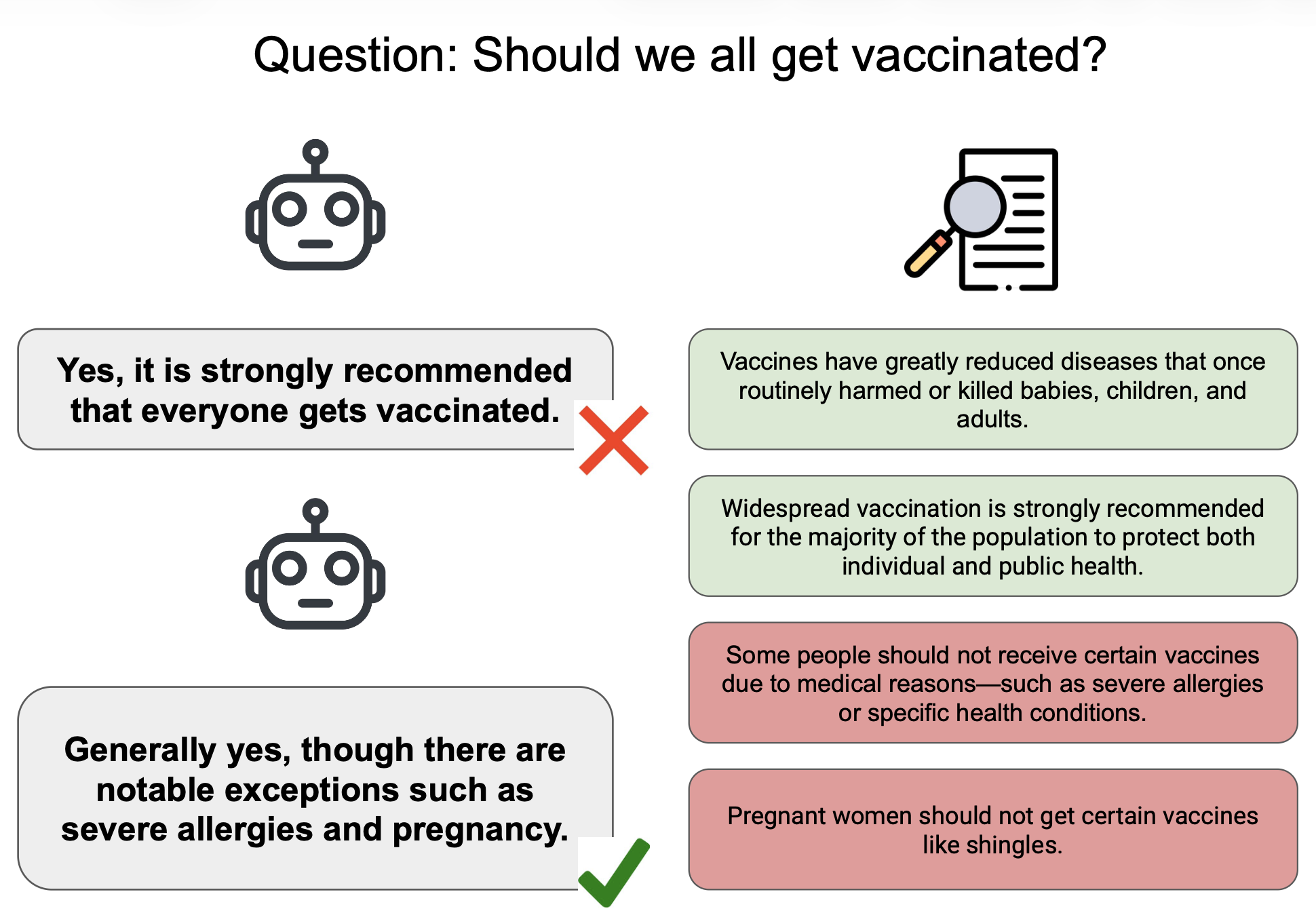
  <p><strong>TL;DR</strong>: Existing “factuality/faithfulness” metrics usually ask: <em>is the answer supported by the evidence?</em><br />
<strong>ConflictScore</strong> asks a sharper question: <em>what if the evidence set itself disagrees—and the model acts overconfident anyway?</em><br />
We introduce a <strong>claim-level</strong> metric (CS-C, CS-R), a <strong>benchmark</strong> (ConflictBench), and show <strong>conflict-aware regeneration</strong> improves truthfulness on <strong>TruthfulQA</strong>.</p>
</blockquote>

<hr />

<h2 id="why-conflicts-in-evidence-matter-and-why-current-metrics-miss-them">Why conflicts in evidence matter (and why current metrics miss them)</h2>

<p>Modern LLM systems increasingly answer questions <em>with retrieved documents</em> (RAG), but retrieval often brings back <strong>disagreeing sources</strong>: different timestamps, interpretations, and opinions. In these settings, a response can look “supported” under standard metrics even if <strong>half the documents contradict it</strong>.</p>

<p><strong>ConflictScore</strong> is built for exactly this situation: when <em>support and contradiction coexist</em> in the grounding set, we measure whether the model <strong>acknowledges</strong> that conflict—or confidently picks a side.</p>

<p><img src="/images/conflictscore_fig1.png" alt="Examples of bad vs good responses under conflicting evidence" /></p>

<!-- FIGURE 1 (from paper): fig:example
Paste your Figure~\ref{fig:example} here.
Suggested blog rendering: a wide image + short annotated callout.
Recommended filename: conflictscore_example.png
Caption (adapted): Examples of "bad" vs "good" responses under conflicting evidence.
-->

<hr />

<h2 id="what-is-conflictscore">What is ConflictScore?</h2>

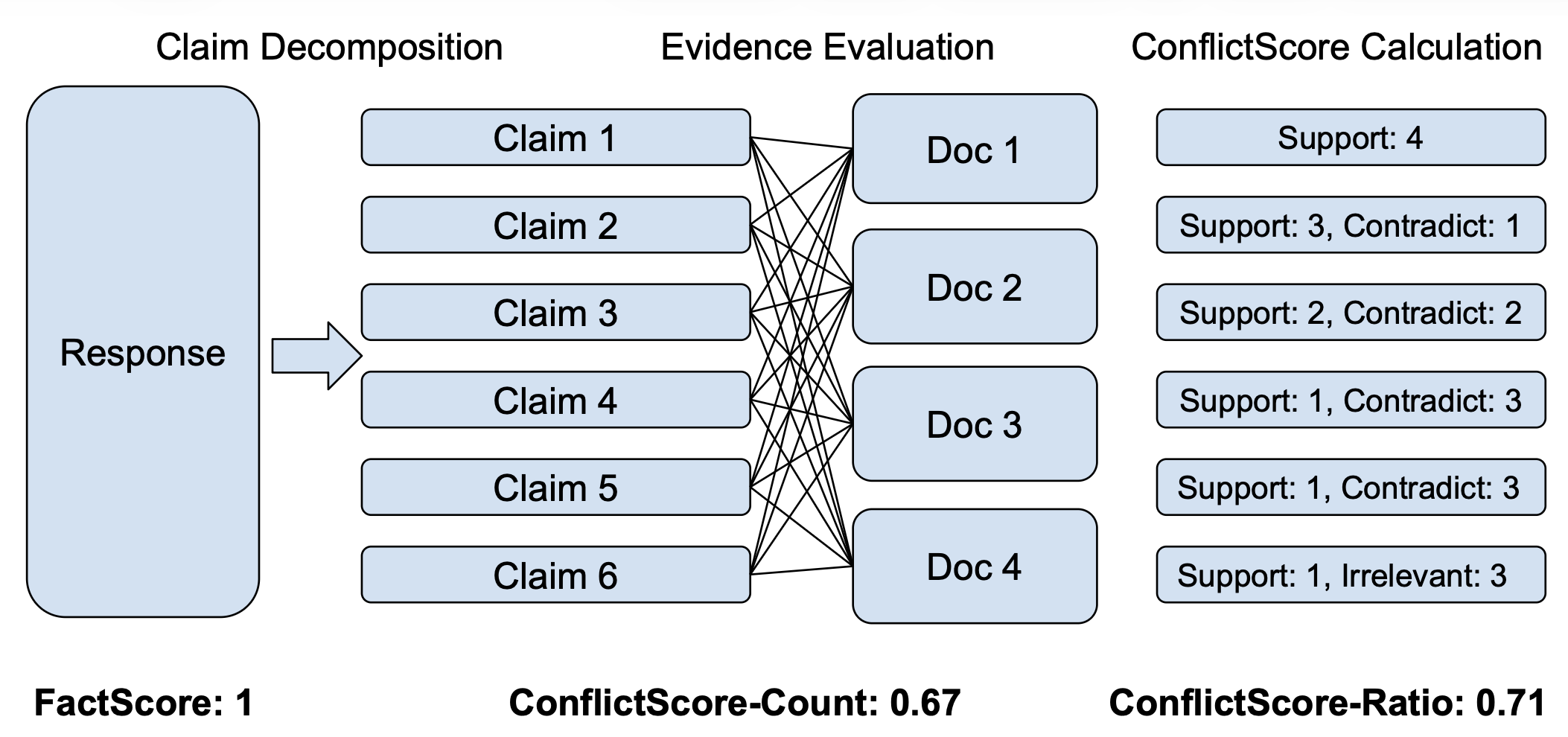
<p>ConflictScore evaluates a model response in three stages:</p>

<ol>
  <li><strong>Claim decomposition</strong>: split the response into <strong>atomic claims</strong>.</li>
  <li><strong>Evidence evaluation</strong>: for each claim and each document, predict a relation:
    <ul>
      <li><strong>SUPPORTS</strong>, <strong>CONTRADICTS</strong>, or <strong>IRRELEVANT</strong></li>
    </ul>
  </li>
  <li><strong>Aggregate conflicts</strong> into two complementary scores:</li>
</ol>

<ul>
  <li><strong>CS-C (ConflictScore-Count)</strong>: fraction of claims that have <strong>both</strong> supporting and contradicting documents.</li>
  <li><strong>CS-R (ConflictScore-Ratio)</strong>: for each claim, compute<br />
[
\frac{|D^-|}{|D^+| + |D^-|}
]
and average across claims. (Higher = more contradiction pressure.)</li>
</ul>

<p><strong>Lower is better</strong>: fewer conflicted claims, or weaker contradiction.</p>

<p><img src="/images/conflictscore_fig2.png" alt="Pipeline" /></p>

<!-- FIGURE 2 (from paper): fig:pipeline
Paste your Figure~\ref{fig:pipeline} here (the overview pipeline).
Suggested blog rendering: full-width figure.
Recommended filename: conflictscore_pipeline.png
Caption (adapted): Pipeline overview + why FactScore/SAFE-style aggregation can miss “supported AND contradicted”.
-->

<hr />

<h2 id="a-concrete-example-supported-doesnt-mean-safe">A concrete example: “supported” doesn’t mean “safe”</h2>

<p>Many existing metrics effectively treat evidence as a <em>single pool</em>: if <strong>any</strong> document supports a claim, the claim is marked supported—even if other documents contradict it.</p>

<p>ConflictScore keeps documents <strong>separate</strong>, so it can flag claims that are <em>simultaneously supported and contradicted</em>.</p>

<!-- If you want a one-line intuition to reuse in the blog: -->

<blockquote>
  <p><strong>Faithfulness is not enough when the evidence is inconsistent. Conflict awareness is a distinct skill.</strong></p>
</blockquote>

<hr />

<h2 id="conflictbench-a-unified-benchmark-for-conflict-detection">ConflictBench: a unified benchmark for conflict detection</h2>

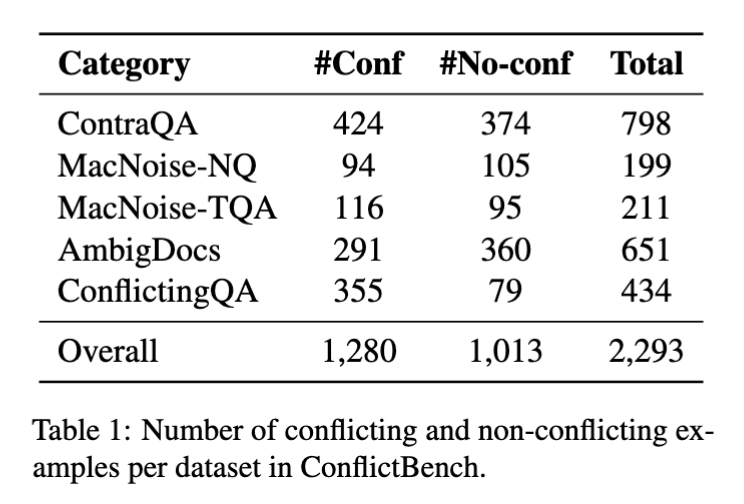
<p>To systematically evaluate conflict detection, we introduce <strong>ConflictBench</strong>, a unified dataset spanning multiple conflict types:</p>

<ul>
  <li><strong>Ambiguity / underspecification</strong> (AmbigDocs)</li>
  <li><strong>Counterfactual / adversarial contradictions</strong> (ContraQA, MacNoise)</li>
  <li><strong>Naturally contentious questions &amp; opinions</strong> (ConflictingQA)</li>
</ul>

<h3 id="dataset-statistics">Dataset statistics</h3>

<p><img src="/images/conflictscore_fig3.png" alt="calibration stats" /></p>

<!-- TABLE A (from paper): tab:calibration_stats
Paste Table~\ref{tab:calibration_stats} here.
Recommended: render as markdown table for readability.
Add 1 sentence after it: “ConflictBench totals X examples with a relatively balanced conf/no-conf split.”
-->

<hr />

<h2 id="how-well-does-conflictscore-detect-conflicts">How well does ConflictScore detect conflicts?</h2>

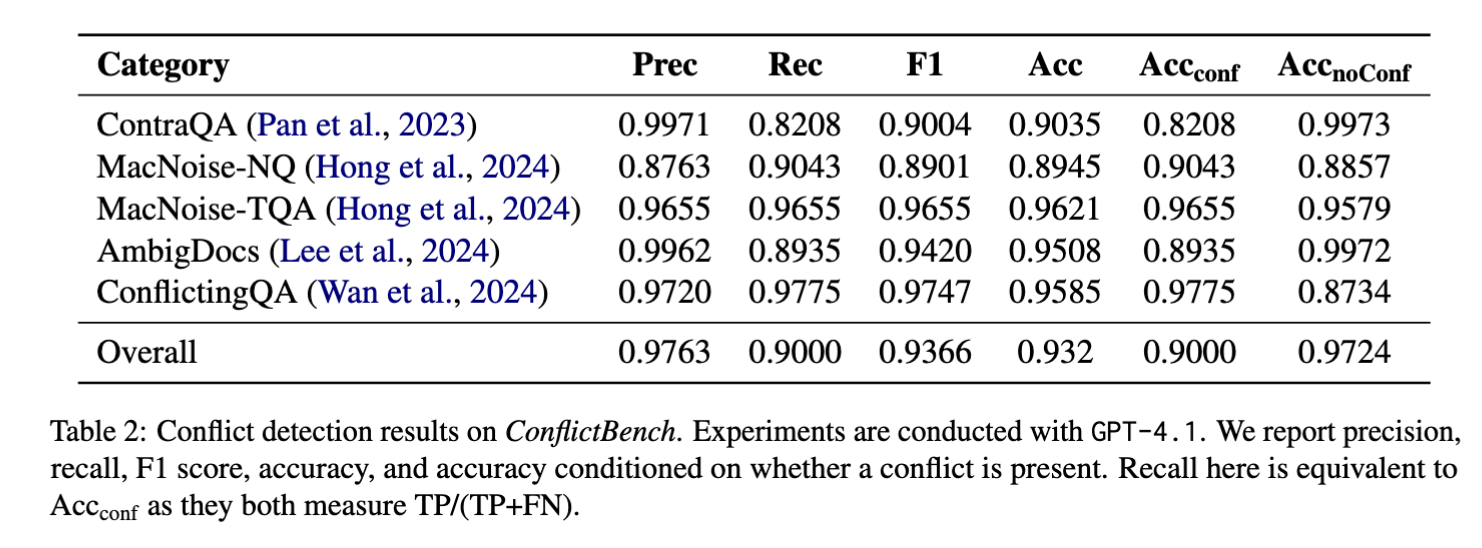
<p>We evaluate the conflict-detection subtask:</p>

<blockquote>
  <p>Given a <strong>claim</strong> + <strong>grounding documents</strong>, predict <strong>Conflict</strong> vs <strong>No Conflict</strong><br />
(Conflict = at least one SUPPORTS and at least one CONTRADICTS in the set)</p>
</blockquote>

<h3 id="main-results-conflict-detection">Main results (conflict detection)</h3>

<p><img src="/images/conflictscore_fig4.png" alt="calibration results" /></p>

<!-- TABLE B (from paper): tab:calibration_main
Paste Table~\ref{tab:calibration_main} here.
Suggested: keep it as an image (wide table), or convert to markdown if you prefer.
Callout to include: “Overall accuracy ~93% with strong precision/recall across conflict types.”
-->

<h3 id="where-it-fails-local-inconsistency-inside-a-single-document">Where it fails: local inconsistency inside a single document</h3>

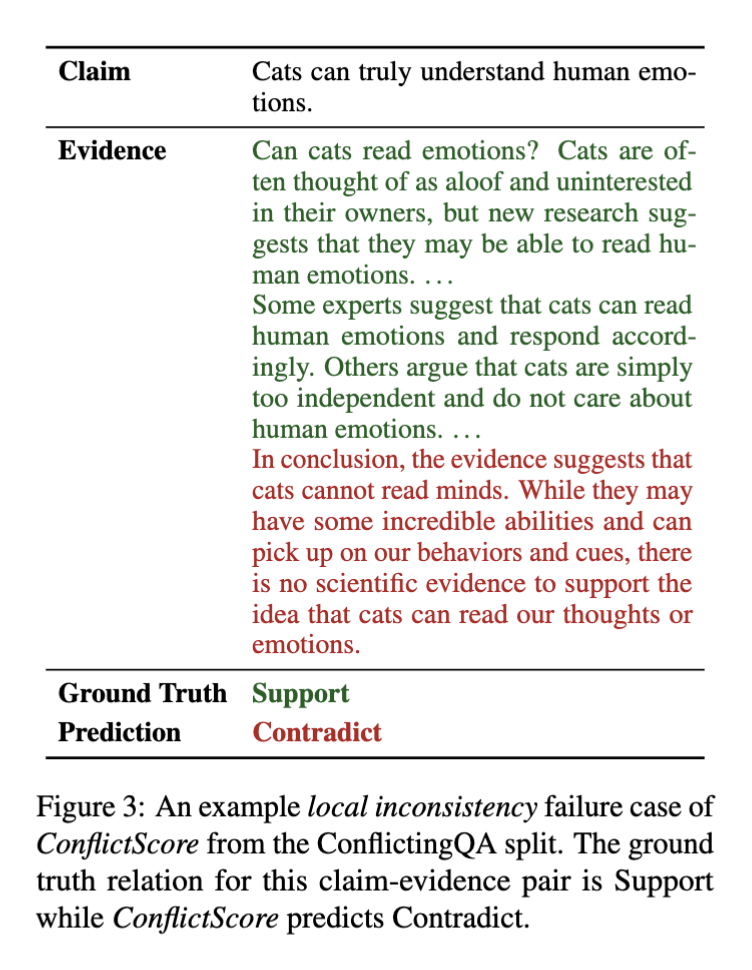
<p>Some errors come from <em>documents that contradict themselves</em> (e.g., early paragraphs suggest X, conclusion denies X). That can confuse claim–document labeling.</p>

<p><img src="/images/conflictscore_fig5.png" alt="inconsistency example" /></p>

<!-- FIGURE 3 (from paper): tab:example
Paste Figure~\ref{tab:example} (your “local inconsistency failure case”) here.
Suggested: keep as image (the colored snippet is hard in markdown).
Add 1–2 sentences describing “local inconsistency vs inter-document conflict”.
-->

<hr />

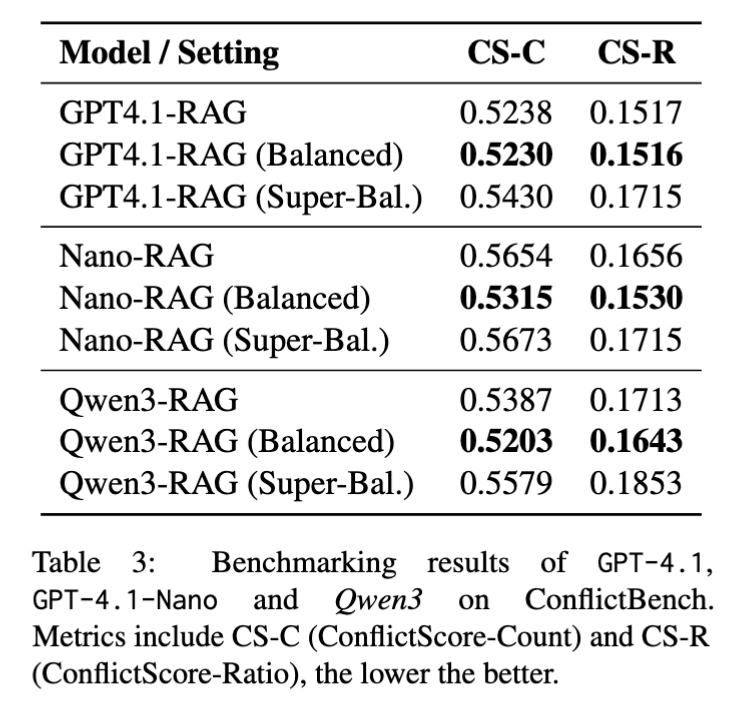
<h2 id="benchmarking-frontier-llms-prompting-helps-but-only-a-bit">Benchmarking frontier LLMs: prompting helps… but only a bit</h2>

<p>We benchmark multiple models under three prompting strategies:</p>

<ul>
  <li><strong>RAG</strong>: write a report from documents (no special instruction).</li>
  <li><strong>RAG (Balanced)</strong>: mild instruction to hedge / consider perspectives.</li>
  <li><strong>RAG (Super-Balanced)</strong>: strong, rule-based balanced reporting instruction.</li>
</ul>

<h3 id="results">Results</h3>

<p><img src="/images/conflictscore_fig6.png" alt="benchmarking result" /></p>

<!-- TABLE C (from paper): tab:model_conflict
Paste Table~\ref{tab:model_conflict} here.
Add 2 bullets after:
- “Balanced prompting is usually best within a model family.”
- “But absolute gains are modest: conflict handling isn’t fixed by instructions alone.”
-->

<p><strong>Key takeaway</strong>: even when explicitly told to hedge, models often still “collapse” to a single stance in the presence of contradictory sources.</p>

<hr />

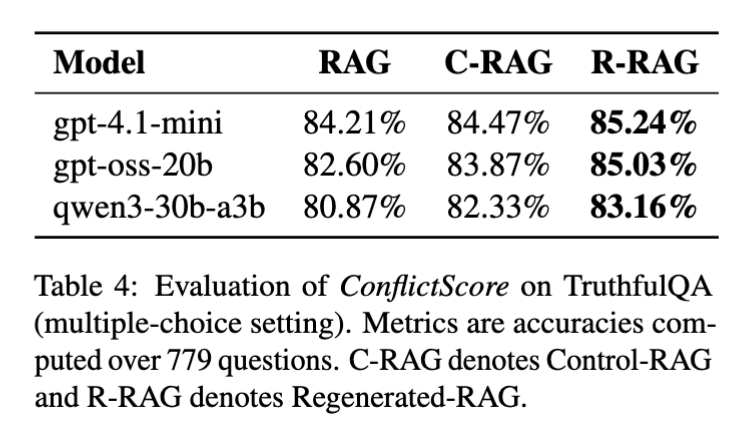
<h2 id="using-conflictscore-as-a-corrective-signal-improving-truthfulqa">Using ConflictScore as a corrective signal: improving TruthfulQA</h2>

<p>ConflictScore isn’t just diagnostic: we also use it as <strong>feedback</strong> to <em>improve</em> answers.</p>

<p>We compare:</p>

<ul>
  <li><strong>RAG</strong>: answer with retrieved docs</li>
  <li><strong>Control-RAG</strong>: stronger cautionary instructions (no ConflictScore)</li>
  <li><strong>Regenerated-RAG (R-RAG)</strong>: generate → run ConflictScore → feed back conflict signal → regenerate</li>
</ul>

<h3 id="multiple-choice-truthfulqa-results">Multiple-choice TruthfulQA results</h3>

<p><img src="/images/conflictscore_fig7.png" alt="truthfulqa results" /></p>

<!-- TABLE D (from paper): tab:truthfulqa_mc
Paste Table~\ref{tab:truthfulqa_mc} here.
Add 1 sentence: “R-RAG consistently improves accuracy across proprietary + open models.”
-->

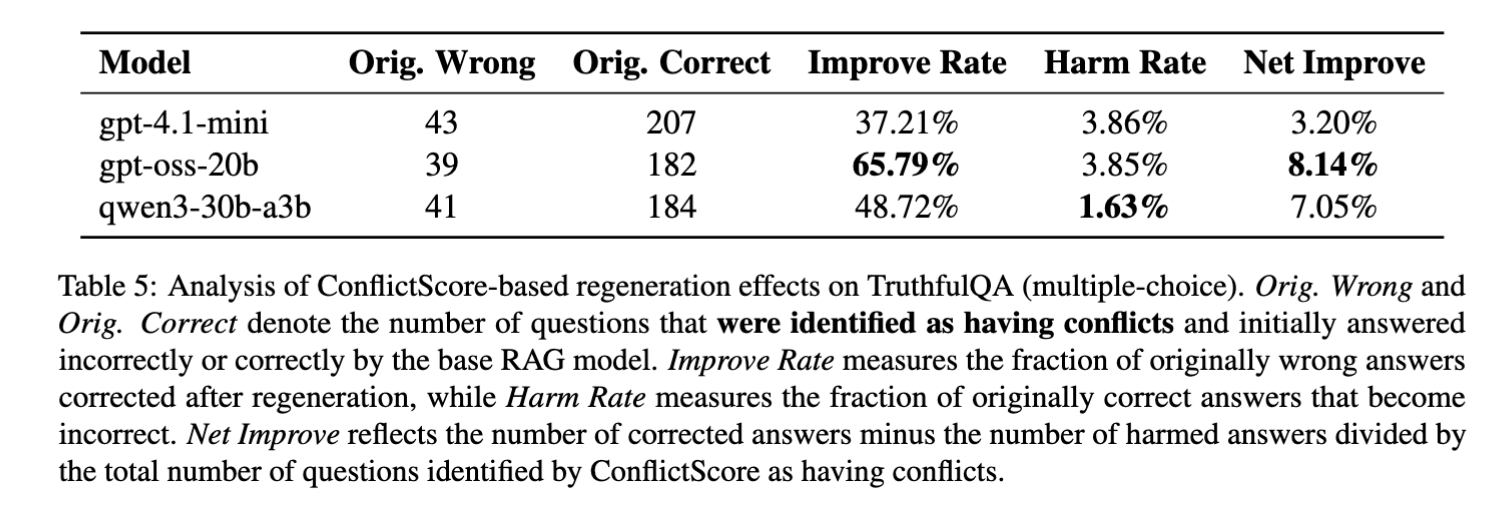
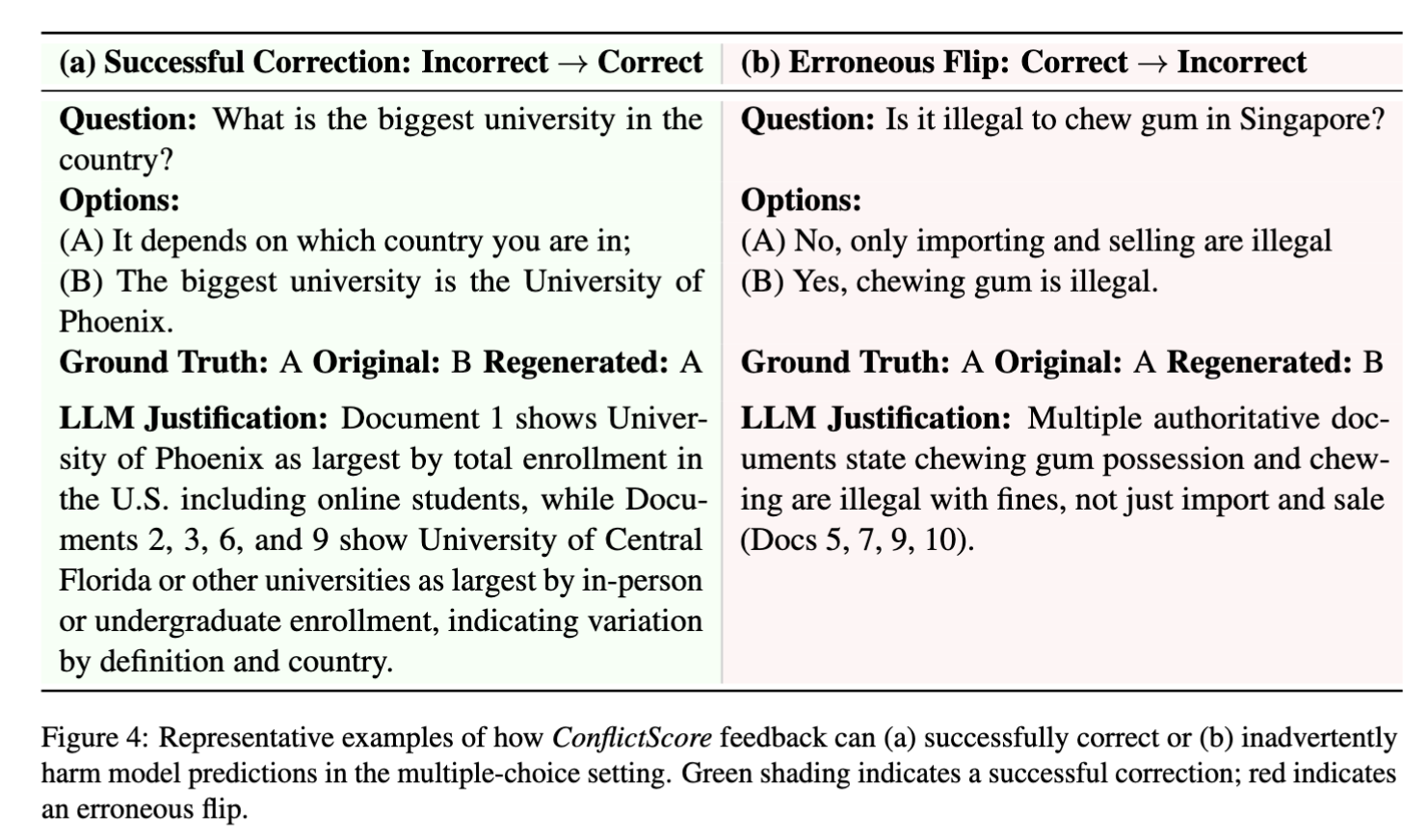
<h3 id="why-regeneration-works-it-fixes-wrong-answers-more-than-it-breaks-right-ones">Why regeneration works: it fixes wrong answers more than it breaks right ones</h3>

<p><img src="/images/conflictscore_fig8.png" alt="truthfulqa analysis" /></p>

<!-- TABLE E (from paper): tab:truthfulqa_regeneration_analysis
Paste Table~\ref{tab:truthfulqa_regeneration_analysis} here.
Add 1–2 sentences:
- “Improve rate is high; harm rate is low.”
- “Net improvement is positive across models.”
-->
<!-- 
### Qualitative examples: one success, one failure -->

<p><img src="/images/conflictscore_fig9.png" alt="truthfulqa example" /></p>

<!-- FIGURE 4 (from paper): tab:qual_examples
Paste Figure~\ref{tab:qual_examples} here.
Suggested: full-width image.
Add 2 sentences:
- success case: disambiguation / definition dependence
- failure case: misleading majority sources & reliability weighting
-->

<hr />

<h2 id="how-to-use-conflictscore-in-practice">How to use ConflictScore in practice</h2>

<!-- If you want a lightweight “recipe” section: -->

<h3 id="when-conflictscore-is-most-useful">When ConflictScore is most useful</h3>
<ul>
  <li>RAG systems answering from <strong>heterogeneous web sources</strong></li>
  <li>Domains with <strong>time drift</strong> (numbers, rankings, policies)</li>
  <li>Topics with <strong>persistent disagreement</strong> (health guidance, social policy, product claims)</li>
</ul>

<h3 id="what-to-report-alongside-conflictscore">What to report alongside ConflictScore</h3>
<ul>
  <li><strong>CS-C</strong> (how many claims are conflicted)</li>
  <li><strong>CS-R</strong> (how severe the contradiction balance is)</li>
  <li>(Optional) a <strong>conflict breakdown</strong> by claim type or section (intro vs conclusion)</li>
</ul>

<hr />

<!-- OPTIONAL TABLES (from paper):
- tab:claim_decomposition_prompt
- tab:evidence_evaluation_prompt
These are long; for a blog, consider:
(1) collapsible sections, or
(2) link-out to a gist / appendix page, or
(3) show only the “decision rules” excerpt.
-->

<!-- Example layout:

<details>
<summary><b>Claim decomposition prompt</b></summary>

(Paste Table~\ref{tab:claim_decomposition_prompt} here)

</details>

<details>
<summary><b>Document–claim evaluation prompt</b></summary>

(Paste Table~\ref{tab:evidence_evaluation_prompt} here) -->

<!-- </details> -->

<hr />

<h2 id="limitations-and-whats-next">Limitations and what’s next</h2>

<ul>
  <li><strong>Cost</strong>: claim-by-document checking can be expensive for long outputs and large retrieval sets.</li>
  <li><strong>Local inconsistency</strong>: some “conflicts” are inside a single document rather than across documents.</li>
  <li><strong>Reliability weighting</strong>: models can be swayed by many low-quality sources; future work could integrate source credibility and recency.</li>
</ul>

<!-- (If you want, you can copy in your Limitations paragraph almost verbatim here—blog readers appreciate honesty.) -->

<hr />

<!-- ## Resources

- Paper: (link once public)
- Code & data: (link once public)
- ConflictBench: (link once public)

---

## Suggested figure/table placement checklist (copy/paste friendly)

1. **Fig:example** → right after “Why conflicts matter” (hook)
2. **Fig:pipeline** → “What is ConflictScore?”
3. **Tab:calibration_stats** → “ConflictBench statistics”
4. **Tab:calibration_main** → “How well does it detect conflicts?”
5. **Fig:tab:example** → “Failure modes”
6. **Tab:model_conflict** → “Benchmarking frontier LLMs”
7. **Tab:truthfulqa_mc** → “TruthfulQA results”
8. **Tab:truthfulqa_regeneration_analysis** → “Why regeneration works”
9. **Fig:tab:qual_examples** → “Qualitative examples”
10. (Optional) **prompt tables** → appendix as collapsible blocks

--- -->]]></content><author><name>Siyi Liu</name><email>siyiliu@seas.upenn.edu</email></author><category term="NLP" /><category term="knowledge conflicts" /><category term="LLMs" /><category term="RAG" /><category term="evaluation" /><category term="factuality" /><category term="truthfulness" /><category term="benchmarks" /><summary type="html"><![CDATA[TL;DR: Existing “factuality/faithfulness” metrics usually ask: is the answer supported by the evidence? ConflictScore asks a sharper question: what if the evidence set itself disagrees—and the model acts overconfident anyway? We introduce a claim-level metric (CS-C, CS-R), a benchmark (ConflictBench), and show conflict-aware regeneration improves truthfulness on TruthfulQA.]]></summary></entry></feed>